A polished portfolio and a competitive quote tell you less than you might think. Here’s a practical framework for evaluating who will actually build your product, how they make decisions, what you should own, and what happens after launch.
Choosing a mobile app development company is difficult for an unusual reason: from the outside, many of them look remarkably similar.
The websites say the same things. Experienced team. Agile process. End-to-end development. Transparent communication. Scalable architecture. The portfolios look polished, and after a few introductory calls, the proposals can start to feel interchangeable.
They aren't.
The differences usually become obvious only after the project has started: who is actually making technical decisions, how scope changes are handled, whether you can see working progress, who owns the infrastructure, and whether the team still answers the phone after the app reaches the store.
Those are difficult things to judge from a proposal.
This guide is a framework for evaluating them before you sign one.
A disclosure before we start: Petadev is a development company, and of course we'd like to be considered when the project fits us. That makes us biased. So the criteria below are deliberately written in a way that can rule us out too. There are projects where another agency, a specialist team or even a good freelancer would be the better choice.
That is part of the evaluation.
The short answer: what should you evaluate?
Don't choose an app development company on portfolio design, hourly rate or company size alone.
Look for evidence that they have shipped products with comparable technical complexity; find out who will actually work on yours; establish what parts of the system they will take responsibility for; make them explain technical decisions rather than simply name a technology; pay close attention to the questions they ask before quoting; understand how scope, milestones and changes are handled; settle ownership before development begins; and find out what the relationship looks like after launch.
There is one signal we pay particular attention to:
Does the company challenge your assumptions before it gives you a price?
A team that finds questions you haven't answered yet is learning how your product works. A team that simply prices the feature list you sent may only be estimating the document.
There is a significant difference between the two.
1. Ask for work you can verify, not just a portfolio page
A portfolio is useful, but it is curated by the company you're evaluating.
Verification is more useful.
For a public consumer product, that may mean opening the app in the App Store or Google Play and actually using it. Look at whether it is still available, whether it has been maintained and whether the product behaves like the case study describes.
But don't make the mistake of assuming every serious software project has a public store listing.
Enterprise applications, internal operational tools and B2B systems may be privately distributed or accessible only to customers. In those cases, ask for a product walkthrough, an appropriate client reference, a live environment they are allowed to demonstrate or another reasonable way of confirming that the system exists and is in production.
More importantly, compare complexity, not appearance.
If your product needs a custom backend, multiple user roles, payments, identity verification and an administration system, ten visually attractive but technically simple apps are less relevant than one product that has already solved several of those problems.
The right question isn't:
“Have you built an app in my exact industry?”
It is:
“Have you solved problems that are technically and operationally similar to mine?”
A strong answer sounds like:
“We haven't built this exact product, but this project had a similar payment model, several user roles and a custom administration layer. We can show you how we approached those parts.”
A weak answer sounds like:
“Here's our portfolio,” followed by screenshots and logos with no clear explanation of what the company actually built.
2. Find out who will actually build your product
The person who sells a software project doesn't necessarily have to write the code. Larger organizations have sales teams, account managers, project managers, architects and engineers for good reasons.
The problem is not structure.
The problem is not knowing the structure until after you sign.
Before choosing a company, understand who scopes the project, who makes technical decisions, who manages delivery and who you will speak to when something goes wrong.
Ask whether development is performed by their own team or subcontracted. Ask whether you can speak to the technical lead before signing. Ask how team changes are handled. Ask who your day-to-day contact will be and whether technical questions can reach an engineer directly.
There are legitimate trade-offs.
A larger company may have more redundancy if someone leaves. A smaller senior team may give you more direct access to the people building the product. Neither model is automatically better.
What matters is that the team you are evaluating is recognizably the team that will deliver.
Strong answer: named people, clear roles and access to someone capable of discussing the architecture before the contract is signed.
Weak answer: “We have a great development team” with no clarity about who will actually work on your project.
3. Establish exactly where their responsibility ends
A mobile app is often only the visible part of the system.
Behind it may sit a backend, database, administration interface, cloud infrastructure, notifications, authentication, analytics, payments, integrations and several different permission levels.
So ask a deceptively simple question:
What exactly are you responsible for?
Some companies specialize only in the mobile layer. That can work perfectly well if you already have an internal backend team.
Others take responsibility for the application and the systems behind it.
Multi-vendor projects can work too, but the boundaries need to be deliberate. If three teams are involved, someone needs to own integration decisions, release coordination and problems that cross from one system into another.
Otherwise the most frustrating failures tend to occur precisely where one team's responsibility meets another's.
For a serious application, you're not only evaluating whether someone can build screens.
You're evaluating whether they understand the system those screens depend on.
4. Make them explain the technology instead of simply naming it
React Native. Flutter. Swift. Kotlin. Node.js. AWS.
Technology names are easy.
Reasoning is harder.
Instead of asking:
“What technology would you use?”
ask:
“Why would you use it for this product?”
A good answer should start with your requirements.
What does the application need from the device? Does it depend heavily on hardware? Does it need background processing? Offline behavior? Real-time communication? How complicated is the backend? What are the performance requirements? Who will maintain the system later?
The technology should follow those questions.
A company that specializes in one stack will naturally know that stack best. That's not a problem. The problem is when every product receives the same technical recommendation regardless of what it has to do.
Strong answer: a recommendation tied to your requirements, including the trade-offs and the conditions under which they would choose something else.
Weak answer: “We use React Native because it's faster and cheaper.”
If you're deciding specifically between native and cross-platform development, we've written a separate guide on that decision. Native vs. Cross-Platform App Development: How to Decide
5. Pay attention to what they ask you
This may be the most useful part of the entire evaluation.
Most companies prepare questions for the development team.
Far fewer evaluate the questions coming back.
Before a team can responsibly define a product, it should understand more than the requested feature list. It needs context around the business, users, existing workflow and constraints.
A serious discovery conversation might explore what users currently do instead of using your product; what happens operationally when a transaction fails; which people need different permissions; why a deadline exists; what existing systems need to be integrated; which requirements are genuinely essential; and what success would look like after the product has been live for a year.
One particularly useful question is:
“If we had to make the first release smaller, what would you remove?”
That question forces prioritization.
It also reveals whether the development team is thinking about your budget as a finite resource rather than simply converting every request into billable work.
No requirements document captures everything that will matter once discovery begins. That's normal. Product development is partly the process of finding the assumptions that were not obvious when the document was written.
If a team asks only enough questions to prepare a quote, it may be estimating your feature list.
If it asks questions that make you reconsider parts of the product, it is beginning to understand the product itself.
6. Understand the scope and milestone structure before comparing prices
Two proposals can show similar totals while describing very different projects.
Before comparing the final number, compare what is actually included.
Does the quote include design? Backend development? Administration tools? App Store and Google Play submission? Cloud setup? Analytics? Testing? Project management? Third-party integrations?
Then look at how the project is divided.
Every stage should produce something concrete that you can inspect. Early stages may produce flows, wireframes, architecture or a written specification. Once development begins, you should start seeing working builds rather than waiting for a final reveal.
A project should not have only two visible states:
started and finished.
You should also understand how payment follows delivery and, critically, what happens when scope changes.
Scope changes are normal.
The useful question is whether the process for dealing with them is normal too.
A good process makes the requested change explicit, identifies its effect on cost and timeline, and gives you a decision before the additional work is performed.
A weak process turns changes into surprise invoices or silently absorbs them until the original deadline becomes meaningless.
Be especially cautious of a precise fixed price for a complex system when very little discovery has happened. Fixed pricing itself isn't the problem. Precision without enough information is.
7. Settle ownership before development begins
Ownership sounds like a legal detail until you need to change development teams.
Then it becomes operational.
A modern application can involve source-code repositories, Apple Developer and Google Play accounts, cloud infrastructure, domains, databases, analytics, payment providers, notification services and third-party credentials.
Before signing, establish which of these belong to your company and which belong to the development provider.
In many custom-development engagements, the cleanest arrangement is for important platform accounts to be created under the client's organization from the beginning, with the development team receiving the access it needs.
That reduces friction if the relationship changes later.
Source-code ownership should also be explicit. Some development businesses transfer the code to the customer. Others retain intellectual property and license the software.
Both can be legitimate models.
What is not a good model is discovering which one you bought after the product has been built.
A useful question is:
“If we decide to work with another team two years from now, what exactly would the handover look like?”
The answer tells you a great deal about how dependent the relationship is designed to become.
8. Ask what happens after launch
The App Store approval is not the end of a software product.
Once real users arrive, assumptions meet real behavior. Operating systems change. Third-party APIs change. Dependencies need updates. Security issues appear. Business processes evolve. Payment edge cases turn up that nobody reproduced during testing.
And successful products usually need new functionality.
Before hiring a development company, ask what support after launch actually means.
Who monitors technical problems? How are bugs prioritized? Is there an agreed response process? Can the same team continue developing the product? What happens if the system needs urgent work? How are small maintenance tasks handled compared with larger feature development?
Then ask something else:
“What is one of the oldest products you still work on?”
Launching software demonstrates one kind of capability.
Keeping software useful for years demonstrates another.
If long-term product ownership matters to you, evaluate both.
9. Don't compare location before you compare the working relationship
There is no universally correct answer to whether you should hire a local, nearshore or offshore development team.
Location can matter.
If your company requires a domestic vendor for procurement or compliance, it matters. If the work requires frequent in-person sessions, it matters. If a highly specific local market context is central to the product, it may matter.
Time-zone overlap and cost can matter too.
But geography alone doesn't tell you how the engagement will actually feel.
Petadev is a useful example of why we think the distinction needs more nuance. Our engineering team is in Budapest, while Petadev also operates through a U.S. entity. That structure obviously shapes our perspective, so factor that bias into this section too.
When evaluating any distributed team, look at availability, communication quality, access to technical decision-makers, delivery visibility and how quickly questions get resolved.
You can test most of those before hiring.
Send a real question during the evaluation process. See who answers it, how well they understand it and whether you need to wait through several layers of account management before reaching someone technical.
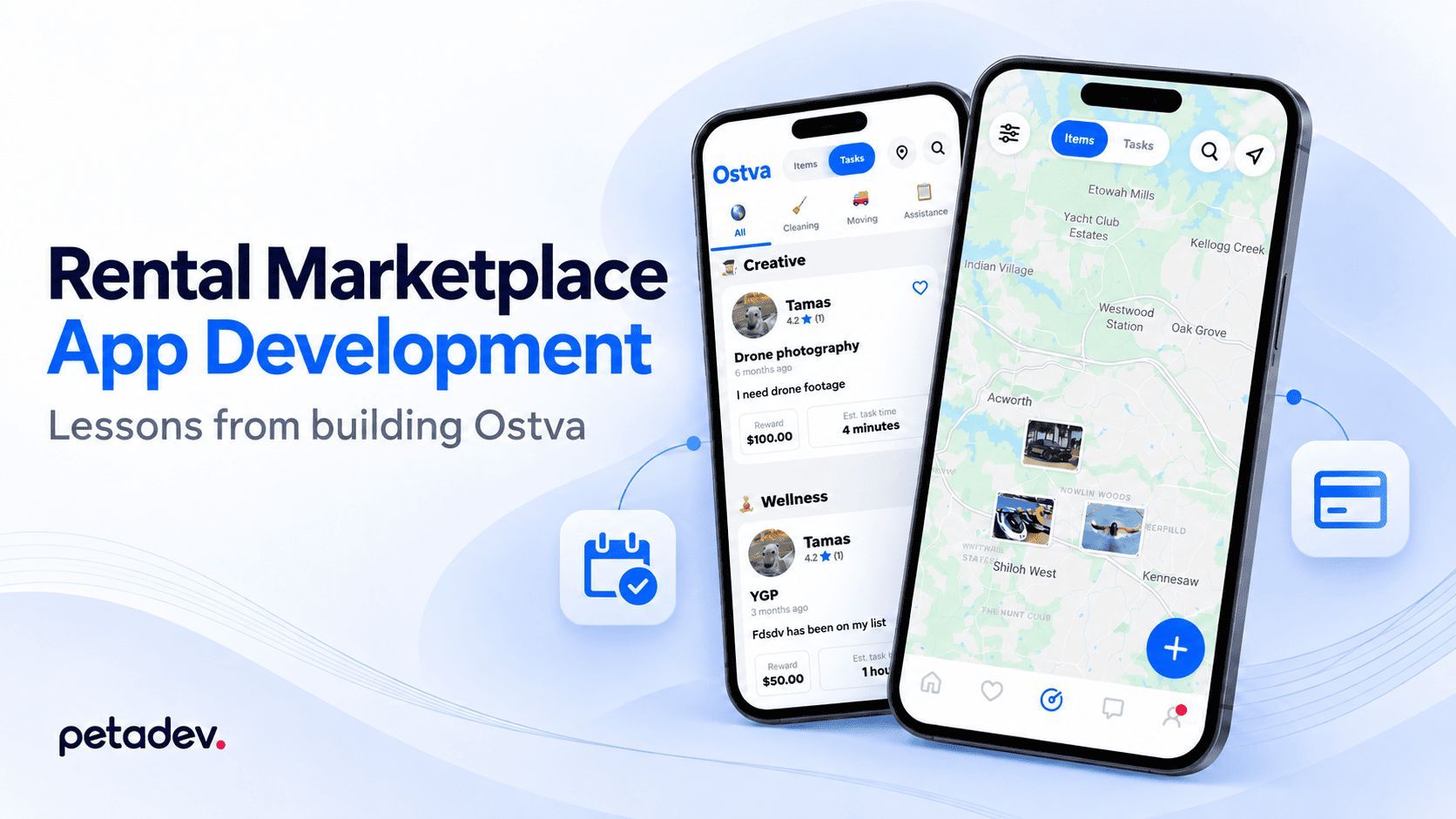
One of our U.S. clients, Ostva founder Thomas Novoszáth, later described working with our Budapest engineering team as feeling no different from working with a development company down the road in Georgia.
That doesn't prove distributed development is always better, or that distance never matters.
It proves that distance and collaboration quality are not the same variable.
Choosing a Development Partner From 4,700 Miles Away: How Ostva Got Built
10. Use reference calls to find problems, not compliments
A testimonial answers the question the company wanted answered.
A reference conversation can answer yours.
Don't spend it asking whether the client was “happy with the work.” The references you receive are unlikely to be people who hated the company.
Instead, ask what went wrong during the project and how the team handled it.
Ask whether delays were communicated before the client noticed them. Ask whether the people doing the work remained consistent through the project. Ask whether the delivered product matched what was agreed. Ask what the client would do differently if the project started again.
Then ask the simplest question:
“Would you hire them again for your next project?”
The explanation matters more than the yes.
If appropriate, ask whether the company can connect you with a client whose project was complicated rather than one where everything went perfectly.
How a development team behaves when something goes wrong is far more informative than how it behaves when nothing does.
Red flags worth investigating
One warning sign rarely tells the whole story.
Several together should slow the decision down.
A precise quote for a complex system without meaningful discovery deserves questions. So does a portfolio that cannot be verified in any reasonable way, vague answers about who will perform the work, ownership postponed until handover, no visible testing process, undefined post-launch responsibilities, or a team that agrees with every technical and product decision you suggest.
Price deserves context too.
The cheapest proposal can absolutely be the right proposal.
But if one quote is dramatically lower than the others, don't immediately ask how they are so efficient. First ask whether all three companies are actually pricing the same product.
Quite often, they aren't.
A practical scorecard for comparing development companies
Score each company from 1 to 5. Don't use the total mechanically: a serious problem with ownership or technical capability can outweigh a good average.
| Criterion | 1 - Weak | 3 - Acceptable | 5 - Strong |
|---|---|---|---|
| Relevant experience | Mostly logos/screenshots | Some verifiable related work | Verifiable products with comparable complexity |
| Team clarity | Unclear who does the work | Roles explained | Named team and access to technical decision-makers |
| Technical reasoning | Technology named without rationale | Basic justification | Recommendation tied to requirements and trade-offs |
| Discovery quality | Mostly asks for features and budget | Covers basic requirements | Surfaces assumptions and questions you had not considered |
| Scope & milestones | Vague delivery plan | Defined stages | Inspectable deliverables and regular working builds |
| Change management | Undefined | Changes discussed as they arise | Clear impact on scope, price and schedule before work begins |
| Ownership | “We'll handle that later” | Contract covers code | Code, accounts, credentials and exit process are explicit |
| Post-launch | Relationship ends at handover | Support available | Clear ongoing support and development model |
| References | Testimonials only | Reference available | Relevant clients willing to discuss real project challenges |
The scorecard isn't meant to turn a complex relationship into a mathematical decision.
Its purpose is to stop one factor, usually price, portfolio design or a convincing sales call, from dominating everything else.
When Petadev may not be the right fit
We work with startups, growing companies and established businesses, from focused MVPs to complex enterprise platforms. Project size isn't what determines whether we're a good fit, and a detailed, well-researched specification is always a welcome starting point.
The one clear exception is game development. We don't have relevant experience there yet, and a studio that specializes in it will do better work than we would. If that's what you're building, we'd rather tell you upfront than three months into the project.
Before you make the decision
A good development company should be able to answer difficult questions about your project.
A better one should also be willing to ask them.
Before you sign, make sure you understand what they have actually built, who will work on yours, what they will be responsible for, why they are recommending a particular technical approach, how changes will be handled, what you will own and whether the relationship has a plan beyond launch.
And pay attention to the conversation itself.
If all you hear is confirmation, you may be buying implementation.
If the team identifies trade-offs, challenges assumptions and helps make the product clearer before there is a contract, you are getting a much better preview of what working together will actually be like.
Evaluating development partners for a project?
Tell us what you're building, what already exists and what you're unsure about. We'll tell you how we would approach it, what we'd want to clarify before estimating it, and whether we think we're the right team for it. If we aren't, we'd rather establish that before either side spends months finding out.