How we built Ostva, a US rental marketplace app, with React Native. Practical lessons on booking approvals, Stripe Connect payments, identity verification, and deciding what belongs in the first release.
Rental Marketplace App Development: Lessons From Building Ostva
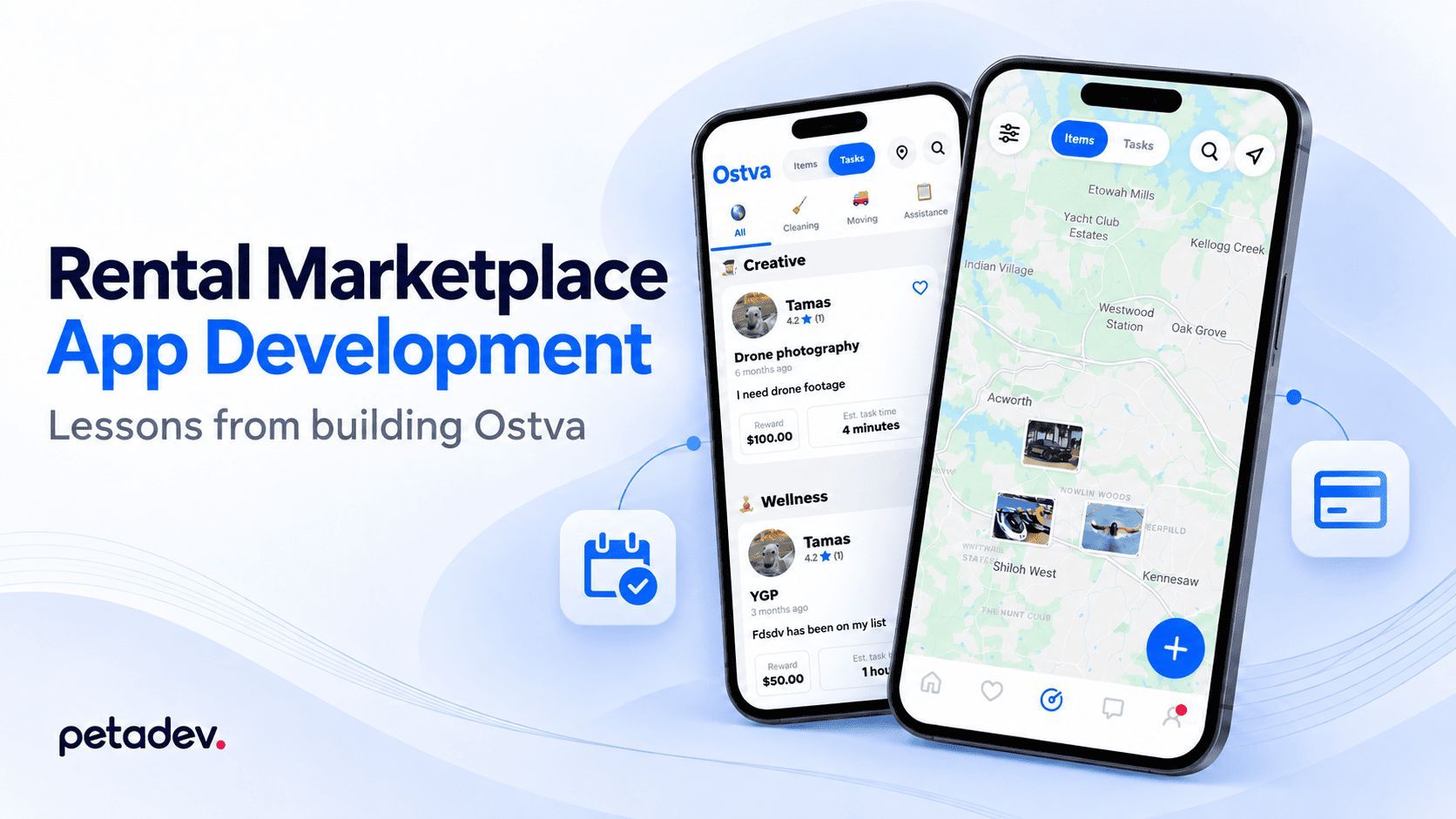
Ostva is a US peer-to-peer marketplace where people rent out items and offer or take on short-term jobs. Petadev built its iOS and Android apps with React Native and Expo, together with a custom backend, a web admin panel, Stripe Connect payment integration and Onfido identity verification. Development of the mobile application took about five months.
For founders planning a rental marketplace, the important decisions go beyond listings and checkout. Who accepts a booking? When is the renter charged? Who can proceed without identity verification? What can an operator do when a transaction needs attention?
This case study explains how those questions shaped Ostva and what we included in its first release. The focus is the rental experience; the product also supports short-term jobs.
Disclosure: Ostva began as a client project. About a year after handover, Petadev founder Martin Szarvas joined Ostva as a co-founder. Petadev continues to maintain and develop the platform.
What Petadev built for Ostva
| Project detail | What we delivered |
|---|---|
| Target market | United States |
| Product | Peer-to-peer marketplace for item rentals and short-term jobs |
| Mobile apps | iOS and Android, using React Native and Expo |
| Backend | Custom backend and API |
| Operations | Web admin panel |
| Payments | Stripe Connect integration, including support for saved cards |
| Identity verification | Onfido integration |
| Design | UI and visual design developed in collaboration with the client |
| Mobile development time | Approximately five months |
| First-release scope | Mobile marketplace and web admin panel; the full browser-based marketplace was left for a later phase |
You can see the product on our Ostva project page. Our earlier Ostva client story covers how the US founder selected and worked with our Budapest team. Here, we focus on the product decisions behind the implementation.
How bookings, payments and payouts fit together
In a rental marketplace, selecting available dates does not necessarily create a confirmed booking. The owner may need to approve the request, and that decision affects both availability and payment.
On Ostva, the booking flow includes four distinct steps:
- The renter requests dates. The request goes to the owner for approval.
- The requested dates are reserved while approval is pending. Other renters cannot book the same item for those dates during that period.
- The card is charged only after the owner accepts. The application keeps booking status and payment status aligned. Saved cards are supported.
- Owner payouts are handled through Stripe Connect. Charging a renter and paying an owner are separate events, which the system tracks separately.
The platform also handles booking conflicts and rental scenarios that require additional rules. The useful lesson for another project is to identify these cases before estimating the build: they can affect availability, payment handling and the tools operators need.
A payment integration alone cannot define your rental process. Your application still needs rules for what a booking means, which actions each person can take and what should happen when the expected sequence changes.
For your own marketplace, start with a simple flow showing the renter, the owner, the platform and the payment provider. Make the approval and payment steps explicit before turning that flow into screens.
Why identity verification happens at booking confirmation
Ostva uses Onfido for identity verification, which is required only when a booking is being finalized. Users can sign up and browse without completing verification.
This timing was a deliberate cost decision. Ostva pays for identity checks per verification, so requiring them at sign-up would also incur costs for people who never book. Placing the check at booking finalization keeps verification tied to the action that requires it.
The application must enforce that requirement at the relevant step and clearly explain what the renter needs to do next. Verification status is part of the rental flow, rather than a separate onboarding task.
For your own marketplace, decide which users need verification and which actions require it. Consider both the customer journey and the requirements that apply to your product and payment provider. Verifying a renter and onboarding someone to receive payouts may serve different purposes.
Why the web admin panel shipped in the first release
When a booking is canceled, a payment fails or a transaction is disputed, the operator needs access to the relevant information and a way to act.
We built Ostva’s web admin panel as part of the first release so the team could inspect transactions and handle cases that required intervention. It was part of the initial operating setup, alongside the customer-facing apps.
Ostva’s admin panel covers:
- user listing and management;
- reviews and reports;
- transactions;
- booking and listing statuses;
- statistics.
When scoping your own marketplace admin panel, useful questions include:
- Can the operator find the user, listing and booking involved in a problem?
- Can they understand the current transaction status?
- Which actions can they take, and which require additional checks?
- Which changes should be recorded so another operator can understand what happened?
The first release needs the controls required to support its actual workflows. Additional reporting and automation can be prioritized as the marketplace develops.
What we left out of the first release
The first version of Ostva provided the marketplace experience through the iOS and Android apps. We left the full browser-based marketplace for a later phase.
The web admin panel was included from the start because the operators needed it. Petadev also built a public-facing website to introduce the product; that is a separate deliverable from a browser-based marketplace where customers can complete rentals.
That gave the first release a clear boundary. Users could complete the core rental experience on mobile, and operators had a web interface to support it. We did not also build the full customer experience for browsers in that phase.
For a rental marketplace MVP, choose the first customer-facing platform based on how you expect people to use the service. Then identify the operational tools needed to support those users. A smaller release still needs a complete path through its core transaction.
What to clarify before requesting a marketplace development quote
You do not need a finished specification to speak with a development team. The following decisions will help that team give you a more useful estimate:
| Question | Why it affects the build |
|---|---|
| Who rents, who owns the items, and can one person do both? | Shapes accounts, permissions and navigation. |
| Are bookings instant or approved by the owner? | Changes availability and booking states. |
| When is the renter charged? | Determines how payment connects to booking approval. |
| How does the platform earn its fee, and how are owners paid? | Affects transaction records and payout integration. |
| Which actions require identity verification? | Affects onboarding and access to rental functions. |
| What happens when a booking is canceled or disputed? | Defines exception handling and operator responsibilities. |
| What must the admin panel support at launch? | Sets the scope of the operational tools. |
| Do users need mobile apps, a browser experience, or both initially? | Determines how many interfaces need to be designed and tested. |
| Which existing systems must the marketplace connect to? | Introduces integration work and external dependencies. |
At Petadev, our current indicative range for complex platforms starts at $80,000. Larger platforms with payments, identity verification and admin systems typically take four to six months. These are planning ranges for new projects, not a disclosure of Ostva’s project price or a fixed quote for every rental marketplace.
See our mobile app development services and pricing for the current ranges, and our app development cost guide for the factors behind an estimate. A smaller first release should be scoped and priced on its own requirements.
Working with an agency on a marketplace app
If you are a digital or marketing agency whose client needs a marketplace, Petadev can deliver the mobile apps, backend and web admin panel as your development partner.
We can work under your agency’s brand or join client meetings as your technical team. The client relationship stays with your agency: if a client you introduced approaches us about additional work, we bring that request back to you rather than quoting independently.
For a defined scope, we can provide a fixed project price broken into milestones, giving your agency a basis for its own proposal and margin. Our engineering team is in Budapest, with availability for calls and messages until 4 p.m. Eastern and a team member in the Atlanta area who can meet agencies in person.
Ostva was a direct client project. It illustrates the technical work we can take on; our white-label mobile app development guide explains the separate agency engagement model.
Planning a rental marketplace?
Tell us what people will rent, who approves bookings, how payments should work and which platforms you want to launch first. If you are an agency, include what your team is handling and where you need a development partner.