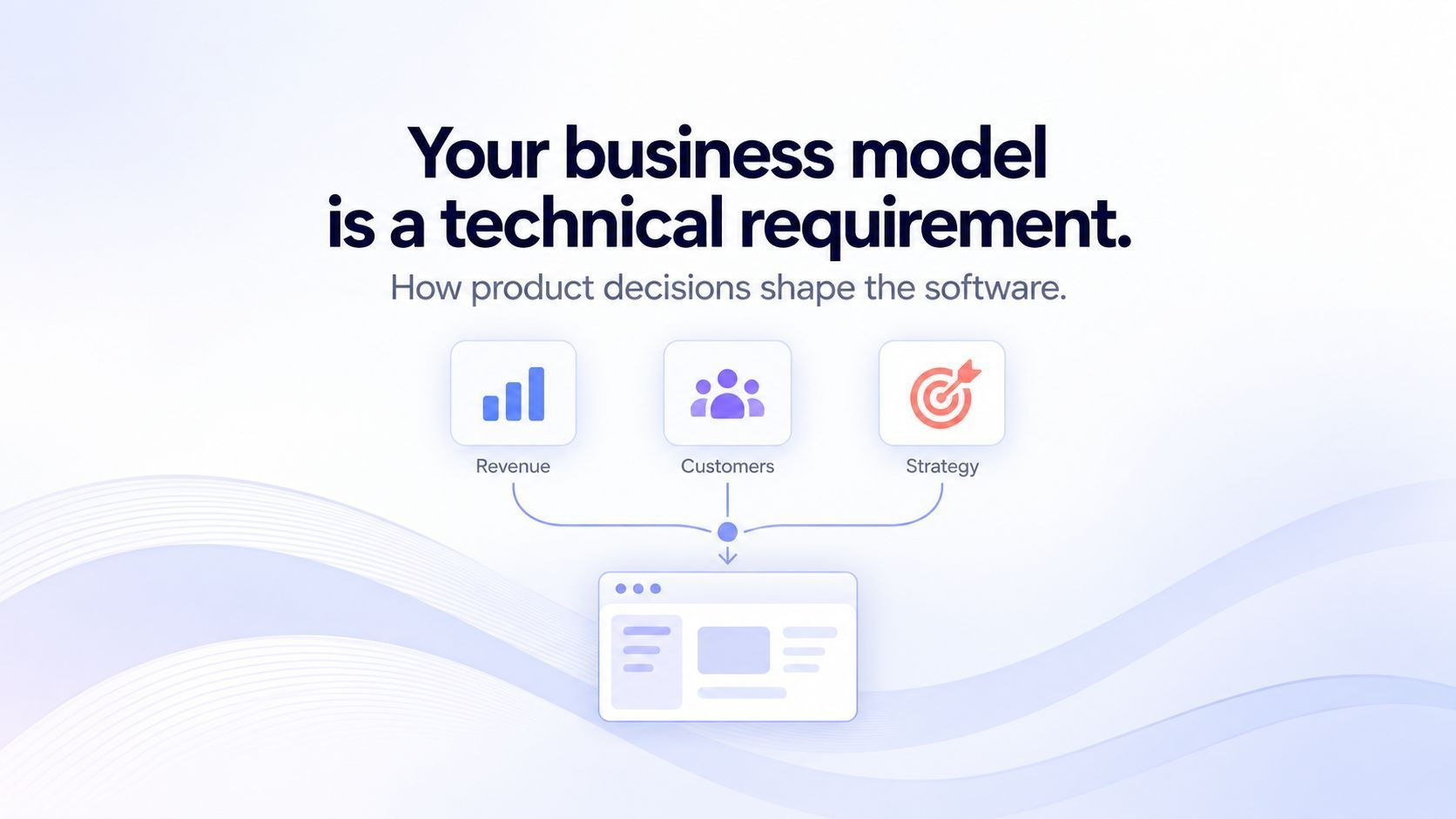
A marketplace, subscription product and B2B platform can look similar on screen while requiring completely different systems underneath. The reason is simple: the business model is part of the technical specification.
Two software products can look surprisingly similar on screen and require completely different systems underneath.
Both may have user accounts, notifications, payments and a dashboard. One might need a relatively straightforward backend. The other may require identity verification, payouts, organization-level permissions, subscription states, audit trails, regional configuration and an administration platform just to operate properly.
The difference is often not the interface. It is how the business works.
That is why one of the first things we want to understand on a software project is not which framework the client prefers. We want to know who uses the product, who pays, how money moves, what different users are allowed to do, who operates the system internally and what should happen when the normal workflow breaks.
Those answers eventually become technical decisions.
They affect the data model, backend logic, permissions, integrations, administration tools and sometimes even infrastructure.
The short answer
A business model affects software architecture because it defines the rules the system has to enforce.
| Business decision | Typical technical consequence |
|---|---|
| Marketplace commission | payments, payouts, transaction states, refunds |
| Subscription pricing | billing lifecycle, entitlements, renewals, cancellations |
| Multiple customer roles | permissions, data access, organization structure |
| Self-service signup | onboarding, provisioning, payments, automated emails |
| Internal operations | administration tools, workflows, reporting |
| International expansion | localization, regional settings, infrastructure |
A marketplace, a subscription product and a B2B platform may share many of the same screens. The systems behind those screens can be very different.
The earlier the structural business rules are understood, the easier it is to make technical decisions that still make sense as the product grows.
Marketplaces: the transaction is the product
A marketplace sounds simple at first.
One group offers something. Another group wants it. The platform connects them.
Most of the difficult engineering starts after that description.
Take payments. Who receives the customer's money? When can it be released? What happens after a cancellation? Can one side dispute the transaction? Does someone need to verify their identity before receiving a payout? What happens if payment succeeds but another part of the transaction fails?
Then there is access.
A buyer, seller, support operator and administrator may all be looking at the same transaction, but they should not necessarily see the same information or be able to perform the same actions.
When we built Ostva, a U.S. peer-to-peer marketplace, those decisions affected far more than the visible booking and payment flow. The way users transact influences the backend, payment infrastructure, user roles, transaction states and the administration tools needed to operate the platform.
What looks like a simple Book or Pay button may sit on top of a chain of rules deciding whether the action is allowed, what happens to the money and which state the transaction moves into next.
That is why designing marketplace software from a list of screens is risky.
You first need to understand the transaction.
Related case study: Choosing a Development Partner From 4,700 Miles Away: How Ostva Got Built
Subscription software needs to understand access, not just payments
A subscription product creates a different type of complexity.
The simple version is familiar:
A customer chooses a plan, enters payment details and gets access.
Real products quickly become more complicated.
A payment may fail. A customer may cancel but retain access until the end of the billing period. They may upgrade or downgrade. A B2B subscription may belong to an organization containing several users rather than to the individual who entered the card details.
At that point, payment status and product access are no longer the same thing.
The system needs to know whether an account is active, what it is entitled to use, who can change the subscription and what should happen after a failed renewal.
This is the difference between integrating a payment provider and implementing a subscription business model.
The payment provider handles parts of the transaction. Your product still needs to understand what that transaction means.
For a self-service product, the impact goes beyond billing. Registration, onboarding, account provisioning, emails, permissions and administration may all depend on the subscription lifecycle.
That is why recurring revenue is not simply a payment feature added near the end of development.
It is product logic.
B2B software usually needs organizations, not just users
A simple application can often start with two roles:
user and admin.
B2B software tends to outgrow that model quickly.
A customer may have several offices, dozens of employees and multiple managers. One supervisor may need access to an entire location while individual employees should see only their own work. Someone may be allowed to manage billing but not operational data. Another user may need reporting access without permission to modify anything.
The system now has to understand more than individual accounts.
It needs concepts such as:
- organizations,
- teams,
- locations,
- roles,
- permissions,
- account ownership,
- relationships between users.
These are business concepts before they are technical concepts.
But once software has to enforce them, they become part of the data model and backend architecture.
Trinity Guard is a useful example. Guards working in the field, supervisors monitoring operations and administrators managing the wider system have genuinely different responsibilities, even though they are working with the same underlying platform.
Designing those relationships early is much easier than building the entire system around individual users and trying to introduce organizational structure later.
International growth changes more than the language
Expanding into another country often starts as a localization conversation.
Translation matters, but it is usually only one part of the problem.
International products may also need to account for different currencies, date formats, time zones, regional configuration, payment methods, operational rules and user expectations.
A good example from our own work is a technical product selector we built for Mercor, a fire-protection company. In that system, the selected region affects both which products are available and which standards apply. The same technical input can therefore lead to a different valid result depending on the market.
That is not localization in the usual sense. It is regional business logic, and it has to be reflected in the product structure and data model from the beginning.
Even time becomes less obvious than it sounds.
Which timezone does a scheduled event belong to? What should an administrator in Europe see when reviewing activity in the United States? Which language should an automated notification use? Should customers in different regions be able to configure the same workflow differently?
Infrastructure may eventually enter the conversation as well.
Trinity Guard began by solving a specific security-operations problem and later grew into an international platform used across multiple regions. As the product expanded, localization, regional operation and infrastructure became larger engineering concerns than they were in the first version.
That does not mean every product with international ambitions needs multi-region infrastructure from day one.
Usually it does not.
It means the expected direction of the business should influence which assumptions are safe to hard-code and which should remain flexible.
E-commerce software has to reflect the business behind the storefront
An e-commerce app may look simple from the customer's side: browse products, add something to the cart, check out and track the order.
But the mobile experience still has to stay aligned with the business behind it. Product information, pricing, availability, customer accounts, promotions and order states all need to remain consistent with the systems running the store.
We saw this while building the mobile app for Szerszámoutlet, one of Hungary's leading online tool retailers. The challenge was not simply recreating a webshop on a smaller screen. The app had to become another reliable customer-facing channel for an existing e-commerce business.
That distinction matters. A new consumer app can define many of its own rules. An app built around an existing retailer has to respect product data, commercial rules and operational processes that already exist elsewhere.
The mobile app is only one part of the commerce system.
The admin side is part of the product
One of the most consistently underestimated parts of a software system is the administration interface.
Customers may spend almost all of their time in the mobile app, but the business operating the product usually needs a completely different set of tools.
Someone may need to approve accounts, change permissions, review transactions, investigate problems, configure organizations, manage content, issue refunds or help a user who cannot complete a workflow.
If every unusual situation requires a developer to edit data manually, the system is not operationally complete.
Admin functionality receives less attention because it rarely appears in App Store screenshots and usually does not sell the product visually.
But it is often where the business rules become most visible.
A marketplace operator needs different controls from a subscription business. A field-operations platform needs different controls from a consumer application. A B2B product may need organization and permission management that would make no sense in a single-user app.
The administration platform is therefore not just a convenience for the internal team.
It is part of the product architecture.
The hardest requirements often begin with “what if?”
The normal workflow is usually the easiest part to describe.
The interesting engineering questions appear when reality does not follow it.
What if a payment succeeds but the next API call fails?
What if a marketplace seller is suspended while active transactions still exist?
What if a field worker loses connectivity halfway through an important workflow?
What if the employee who originally created a company account leaves?
What if a subscription expires while several users are still logged in?
Most businesses already have an instinctive answer to questions like these, even if nobody has formally documented it.
Software forces the answer to become explicit.
That is why useful discovery conversations often contain questions that sound more operational than technical:
What should happen if this fails?
Who is allowed to override it?
When does this transaction become final?
Can this action be undone?
Who needs to be notified?
The answers become software rules.
This is also why a development team can learn more about a product by understanding its exceptions than by reading another page of screen descriptions.
Some changes are cheap. Others reach deep into the system.
Products change during development. That is normal.
In many cases, changing the product after learning something new is exactly what should happen.
The useful distinction is between surface changes and structural changes.
Changing copy, moving a screen or simplifying part of onboarding may be relatively contained.
Changing how money moves through a marketplace may affect payments, transaction logic, administration tools and existing data. Introducing a new B2B user type may require new permission rules across the system. Moving from manually provisioned accounts to a fully self-service product can affect onboarding, billing and account architecture.
The goal is not to predict every future feature.
It is to identify the business decisions that influence the foundation while they are still relatively inexpensive to reconsider.
At the same time, building for every possible future business model is usually a mistake too. Over-engineering hypothetical scenarios creates complexity that the current product may never need.
The better approach is to build for the model you understand today while avoiding unnecessary assumptions that make the most plausible next step unusually difficult.
Six questions worth answering before architecture decisions are made
You do not need to know the technical architecture before speaking with a development team.
But these questions should become clear early:
1. Who pays, and what are they paying for?
Is the model a one-time purchase, subscription, transaction fee, commission, per-seat license or something else?
2. Does money move only to your company, or between users?
That distinction can fundamentally change payment flows, identity requirements and transaction logic.
3. Is the buyer also the user?
In many B2B products, the person paying for the software is not the person using it every day.
4. Will customers use the product without speaking to your team?
Self-service affects much more than marketing. It can require automated onboarding, account creation, billing and support flows.
5. Which markets does the product need to support?
Even if international expansion comes later, knowing that it is realistic can influence early decisions around localization, configuration and infrastructure.
6. What existing systems does the product need to work with?
Payments, ERP systems, CRMs, identity providers, maps, government APIs and other integrations can materially affect both architecture and scope.
A development team does not need every answer before the first conversation.
But if none of these topics come up before a detailed estimate is produced, the team may know the requested features without yet understanding the product.
We covered this more broadly in our guide to evaluating a mobile app development company before you hire one.
A good specification describes the rules behind the features
“Users can book a service” describes a feature.
It does not yet explain how the business works.
Who can offer the service? When does a booking become binding? Can either side cancel? Does cancellation affect payment? What does the platform earn? Can an administrator override the status? What happens when somebody does not show up?
A detailed specification is an excellent starting point, but no document needs to predict every edge case before development begins.
The purpose of discovery is not to write a perfect document.
It is to uncover the assumptions behind the requirements and identify the ones that can shape the architecture.
That distinction matters because changing the visual implementation of a feature later may be easy. Changing the business meaning of a transaction can affect several systems at once.
Business model first. Architecture second.
A marketplace needs software that understands transactions between several parties.
A subscription product needs software that understands access over time.
A B2B platform needs software that understands organizations and permissions.
An international product needs software that can adapt as users and operations spread across different markets.
The technologies used to build those systems matter.
React Native, Swift, Kotlin, Node.js, AWS or any other tool may be the right choice depending on the product.
But the technology should follow the requirements rather than define them.
Tell us how the product needs to work. The architecture can follow from there.
The starting point is understanding what the business needs the software to do.
That is why we consider the business model part of the technical specification.
Building a product where the business logic matters?
Tell us how your product needs to work, who uses it, and how the business operates. We’ll help turn those requirements into the right product and technical architecture.